- The Baking Sheet
- Posts
- The Baking Sheet - Issue #292
The Baking Sheet - Issue #292
Tallinn Goes Live: Faster Blocks, Stronger Security, Leaner Storage.

Here we go again.
This week feels like a real turning point. After a busy stretch of preparation, testing, and coordination across the ecosystem, Tezos starts the next chapter with some very tangible progress now live on mainnet. The pace has picked back up, and you can feel the shift from planning to execution.
At the protocol level, Tezos just activated its 20th on-chain upgrade, delivering faster blocks, stronger security mechanics, and meaningful efficiency gains for applications that scale. Alongside that, new pieces of the broader Tezos X roadmap are beginning to show up in public, giving builders more surfaces to experiment on and extend what already works.
Around the ecosystem, infrastructure support continues to deepen. Wallets, validators, and tooling providers are moving closer to the protocol itself, not just integrating with Tezos, but actively participating in its operation and governance. At the same time, art, culture, and exhibitions remain an anchor point, reminding us that Tezos is not only about performance, but about long-term creative and institutional presence.
This week’s edition brings all of that together. From Tallinn going live, to new test networks, validator announcements, and cultural programming, it is a snapshot of Tezos doing what it does best: shipping upgrades without disruption, welcoming new participants, and expanding in multiple directions at once.
Let’s get into it.
After weeks of preparation across the network, Tallinn is officially live.
On January 24, 2026 at 16:06:56 UTC, the Tezos blockchain activated Tallinn, its 20th protocol upgrade, at block 11,640,289. Twenty upgrades in, the pattern is familiar but no less meaningful: a proposal debated in the open, adopted through on-chain governance, and activated without disruption. It is one of those moments that quietly reinforces why Tezos continues to age differently than most networks.
Tallinn focuses on three concrete improvements that show up immediately in how the network feels and scales.
First, block time on Layer 1 drops from 8 seconds to 6. That brings finality down to 12 seconds and makes everyday interactions feel noticeably tighter. It also benefits Etherlink, since Layer 2 data availability is anchored to Layer 1 inclusion.
Second, Tallinn enables a shift toward all bakers attesting every block, once at least 50 percent of bakers have adopted tz4 consensus keys. This builds on the BLS aggregation work introduced in Seoul and moves the network toward stronger security, more predictable attestation rewards, and lighter node load. Importantly, this change is gated. Baking with tz1, tz2, or tz3 addresses remains supported, only the consensus key needs to be tz4, and no one is forced off the network mid-flight.
Finally, Tallinn introduces the Address Indexing Registry. For applications with large ledgers, especially NFT platforms and enterprise-scale contracts, this can reduce storage usage by up to 100 times. Less duplication on-chain means lower costs for builders, slower long-term storage growth for the network, and more room for throughput as usage increases. Existing contracts will need to opt in, but the upside is substantial.

As with every Tezos upgrade, this one only worked because of the ecosystem around it. Bakers testing early, teams validating assumptions, and operators upgrading infrastructure ahead of activation are what make these transitions routine instead of risky.
Tallinn is designed to be a structural upgrade. Faster where it matters, leaner where it counts, and carefully staged to keep the network accessible. Twenty upgrades in, that rhythm is very much the point as we keep executing the Tezos X roadmap.
Welcome to Tallinn.

Ledger Support Lands on Etherlink: Self-Custody, End to End
Right on the heels of Tallinn going live, another piece of the Etherlink stack has clicked into place.
Full support for tez on Etherlink is now live in Ledger, bringing hardware-secured self-custody directly into the EVM side of the Tezos ecosystem. That means users can interact with Etherlink apps without giving up control of their keys or relying on hot wallets for day-to-day activity.
With this update, Ledger users get a familiar, end-to-end experience:
Secure self-custody backed by Ledger hardware
Clear Signing, so transaction details are human-readable before approval
Native swap support
Compatibility across both desktop and mobile wallets
More importantly, Ledger can now be used to interact directly with major Etherlink applications, including Curve Finance, OKU Trade, Hanji Protocol, Superlend, and Uranium.io, all while staying in self-custody.
For users, this lowers friction. For builders, it removes a common blocker to adoption. Hardware wallet support is often the difference between experimentation and real usage, especially for DeFi, trading, and higher-value positions.
As Etherlink also continues to evolve, integrations like this matter. Faster confirmations and higher throughput are only part of the story. Trust, clarity, and safe key management are what let people actually use the network with confidence. Ledger support brings that foundation firmly into place.
This Week in the Tezos Ecosystem
Tezlink Shadownet Goes Live: Michelson, Now Beyond Layer 1
As Etherlink continues to push the EVM side of Tezos forward, another part of the Tezos X roadmap quietly reached an important milestone.
Tezlink Shadownet is now live, marking the first public test network for Tezlink and the first time Michelson smart contracts can be tested in a new execution environment beyond Tezos Layer 1.
At a high level, Tezlink is about continuity. It brings Michelson compatibility into a more scalable runtime designed for lower latency and lower fees, without asking builders to abandon the tools, languages, or mental models they already use. Contracts written in Michelson, SmartPy, or Ligo can run in this environment without being rewritten, preserving years of ecosystem knowledge while opening the door to new performance characteristics.
Shadownet is the first place to try this in practice.
What builders can do today
On Tezlink Shadownet, developers can deploy and interact with Michelson-based applications in a public test environment that supports most of the features commonly used on Layer 1:
Implicit accounts, transfers, and reveals
Contract originations and calls
Views, big maps, and internal operations
For many existing contracts, this means real workloads can be deployed with little or no modification, making Shadownet useful for testing more than toy examples.
Some Layer 1 features, such as delegation, voting, and attestations, are intentionally excluded, since they do not apply in a rollup context. Gas and fee behavior is also experimental at this stage and expected to evolve as the network matures.
Operationally, Shadownet currently runs with a single sequencer operated by Nomadic Labs. This keeps the environment stable while the runtime, tooling, and assumptions are still being refined based on early feedback.
How Tezlink fits into the bigger picture
Tezlink is designed to run alongside other runtimes on Tezos, including Etherlink. Rather than fragmenting the ecosystem by forcing everyone into a single execution model, the goal is to let different runtimes coexist and eventually interoperate.
That future includes atomic composability across runtimes, where contracts deployed on Tezlink can interact directly with contracts on Etherlink and beyond. That capability is not enabled yet, but it is the next major milestone. A shared-sequencer test network, where Tezlink and Etherlink run side by side, is expected to arrive later as part of the Tezos X roadmap.
Other features, such as BLS cryptography support, ticket transfers, Sapling, events, and instant confirmations, are also planned for future iterations.
Tezlink Shadownet is an early step, but an important one. It gives Michelson-based builders a place to experiment, validate assumptions, and influence how this part of the stack takes shape before it hardens.
For developers, it means continuity with room to grow. For users, it points toward faster interactions and richer applications without losing what makes Tezos development distinct.
Shadownet is open now, and early feedback is encouraged. This is the stage where questions, edge cases, and rough spots are not just expected, they are essential.
Meria Joins Tezos as a Validator
Tezos also continues to deepen its validator base, and this week that momentum comes from France.
Meria, one of France’s leading regulated crypto investment and staking platforms, has officially begun operating as a baker on the Tezos network. By running its own validator infrastructure, Meria now participates directly in block production and transaction validation, contributing to the network’s security and day-to-day operation.
For Meria, this is a natural extension of what it already offers users. The platform is a fully regulated PSAN provider in France and serves hundreds of thousands of customers with crypto buying, staking, and lending services. Operating a Tezos baker allows Meria to strengthen its XTZ staking offering while taking a more active role in the underlying network it supports.
Meria’s staking services already allow retail users to earn rewards while contributing to the security of proof-of-stake networks like Tezos, Ethereum, and Solana. By becoming a baker itself, Meria brings that contribution one layer deeper, aligning its infrastructure directly with the protocol.
As Thibaut Boutrou, COO of Meria, put it:
“Tezos is one of the pioneering proof-of-stake protocols in our industry. By operating a baker, Meria is proud to actively contribute to a network with which we share a long history and strong francophone roots.”
The timing also matters. Interest in proof-of-stake infrastructure continues to grow, and Tezos has seen a steady flow of new ecosystem participants in recent months. Alongside ongoing protocol upgrades and increased governance activity, the arrival of new professional validators reinforces the network’s long-term resilience.
For Tezos, Meria’s participation adds another experienced, regulated European operator to the validator set. For Meria, it means more competitive and transparent staking conditions for users, and a direct voice in Tezos on-chain governance.
It is another example of how Tezos continues to attract long-term participants who are willing to move beyond surface-level integrations and invest directly in the network’s core infrastructure.
Events
Big conference days tend to start fast, and ETHDenver is no exception. To make the morning a little easier, the Tezos Breakfast Club is back with a relaxed meetup designed to fuel conversations before the day gets busy.
If you skipped the hotel breakfast or just want a familiar place to land, this is a low-key stop for the Tezos community to connect over coffee and pastries before heading into the conference.
What to Expect
Complimentary coffee and fresh baked goods
Casual conversations about Tezos, Etherlink, and what people are building
Exclusive giveaways for attendees
A friendly starting point to ease into the ETHDenver schedule
The Breakfast Club is meant to stay simple. No panels, no presentations, just a chance to catch up with builders, artists, and ecosystem teams in a comfortable setting.
Event Details
Location: The Wild, 1660 Wynkoop St Suite 100, Denver, CO
When: During ETHDenver week
Registration: Spots are limited, so early sign-up is recommended
Grab a coffee, grab a pastry, and start your ETHDenver week with good conversations and familiar faces.
One More Thing…
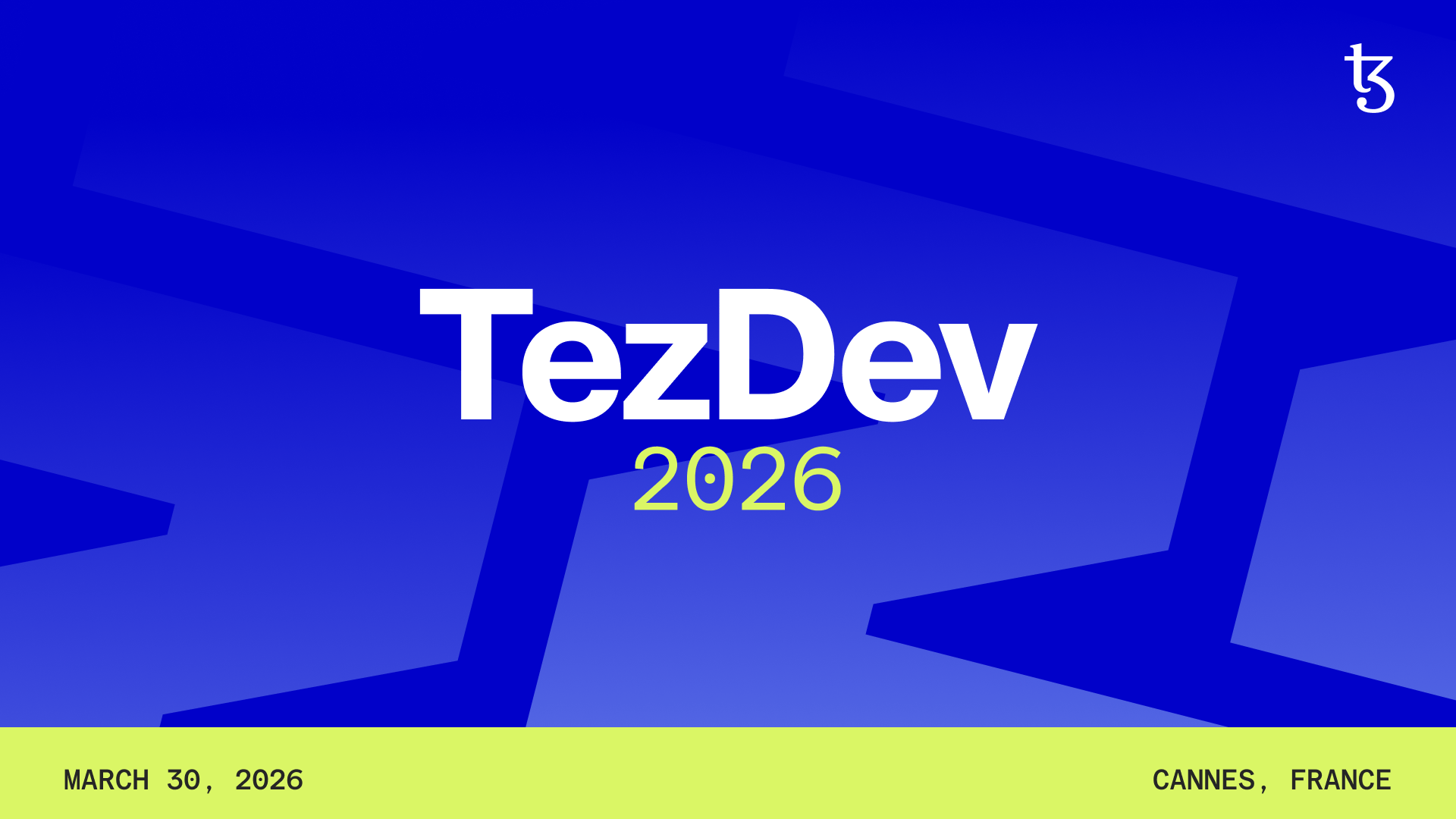
We’re giving first details exclusively to you, our loyal subscribers. More information will be revealed in the near future, but save the date for Tez/Dev 2026!
🔴 Now Streaming: How Tesserart Is Rethinking Tools for Tezos Artists
This week on TezTalks Live, host Stu sits down with Ibon Escalada, developer at Tesserart and longtime Tezos art collector, to explore how artists can take greater control of their work in the blockchain art space.
Ibon’s path into Tezos began as a collector drawn to the work, the artists, and the culture that formed around them. Over time, that curiosity turned into building.
In this conversation, he shares how those experiences shaped Tesserart and its Storefront platform, created to help artists bring their work on-chain without unnecessary friction.
Watch the full episode on YouTube.